What Happened
On Wednesday, August 5, 2026, the Congressional Budget Office (CBO) released a report detailing the projected costs for the U.S. Navy's new nuclear-powered battleship procurement program. The report estimates the total cost for 15 'Trump-class' guided missile battleships (BBG(X)) at an
What the Evidence Establishes
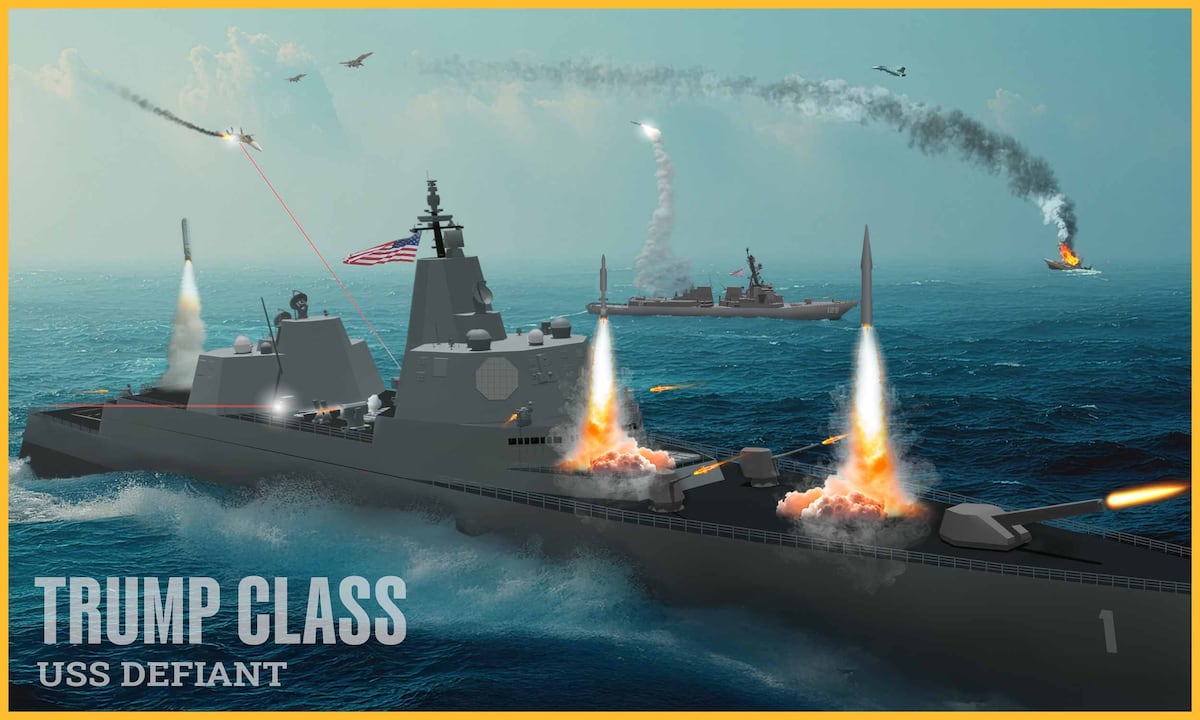
The CBO report, published on Wednesday, August 5, 2026, establishes that the Trump-class battleship program is projected to cost $275 billion for 15 vessels. The initial ship, designated BBG(X), is estimated at $23.4 billion, with subsequent 14 ships each costing $18 billion. These vessels are designed to be 35,000-ton nuclear battleships, making them the largest surface combatants built for the Navy since World War II, more than three and a half times the size of an Arleigh Burke-class destroyer and over twice the size of a Zumwalt-class destroyer. The USS Gerald R. Ford, a nuclear-powered aircraft carrier, cost approximately $13.3 billion by comparison.
The ships are intended to be heavily armed, featuring anti-air, land-attack, and anti-ship missiles, hypersonic missiles, nuclear cruise missiles, large lasers, and a rail gun. The Navy's procurement timeline projects the construction of 15 Trump-class battleships between 2028 and 2056, requiring a new battleship to be built approximately every other year while maintaining the production of two DDG-51 destroyers annually. This plan necessitates a 60 percent increase in the total tonnage of large surface combatants constructed by 2058, posing a significant challenge for the U.S. shipbuilding industry. A March GAO report highlighted nearly two decades of insufficient shipbuilding, with new vessels failing to meet expectations and experiencing delivery delays of up to three years. Shelby S. Oakley, a GAO director, stated to the Senate Armed Services Committee that
Where the Accounts Conflict
The primary sources, Defense News and The Hill, largely corroborate the central figures and findings of the Congressional Budget Office report regarding the Trump-class battleship program. Both outlets cite the $275 billion total cost and the $23.4 billion price tag for the first vessel. However, the Defense News article provides additional detail regarding the evolution of cost projections, noting that the updated $23.4 billion for the first ship is
Context and Stakes
The proposed Trump-class battleship program represents a significant strategic shift for the U.S. Navy, moving towards larger, more heavily armed surface combatants. This initiative, announced by the Trump administration in December, aims to bolster the Navy's
What to Watch Next
Observers should monitor congressional reactions to the CBO report, particularly from members of the Senate Armed Services Committee and House Armed Services Committee. Specific attention should be paid to any statements or hearings scheduled by committee chairs or ranking members regarding the program's feasibility and cost-effectiveness. The Navy's response to the CBO's cost projections and the GAO's prior findings on shipbuilding capacity will also be critical. Any adjustments to the proposed acquisition timeline or ship specifications could indicate internal reassessments.
Furthermore, the defense industry's capacity to meet the ambitious shipbuilding schedule, which requires a battleship every other year from 2028 to 2056, warrants close observation. Announcements from major shipbuilders like Huntington Ingalls Industries or General Dynamics regarding facility expansions, workforce development, or new technological investments could signal their readiness to undertake such a massive program. Any legislative efforts to allocate funding or mandate specific production targets for these battleships will also be a key indicator of the program's political viability and progression. The next federal budget cycle will provide a clearer picture of initial funding commitments.
Bottom Line
The U.S. Navy's proposed Trump-class battleship program faces substantial financial and industrial challenges, with a CBO-estimated cost of $275 billion for 15 nuclear-powered vessels. While these ships promise unprecedented firepower and size, the program's viability is complicated by a history of U.S. shipbuilding delays and cost overruns, as highlighted by the Government Accountability Office. The initial cost projection for the first ship has already increased by $6 billion since the December announcement, indicating potential for further escalation.
The strategic shift towards larger surface combatants aims to enhance naval power projection, but its execution hinges on overcoming significant hurdles in manufacturing capacity and budget allocation. The long-term operational savings from nuclear power are noted, but the immense upfront capital investment and the industry's current limitations present immediate obstacles. The program's progression will depend heavily on sustained political will, effective oversight, and the shipbuilding sector's ability to rapidly scale production and improve efficiency, a task that has proven difficult over the past two decades.
DECLASSIFIED SOURCE: Defense News (via Real-time Signal Upgrade)
Separate what looks backed, what is changing, and what still needs proof.
A Congressional Budget Office report estimates the Navy's proposed 15 Trump-class nuclear battleships will cost $275 billion, with the first ship at $23.4 billion.
Spending $23.4 billion on a single ship seems like a massive waste when drone technology has made large surface vessels such easy targets. Wouldn't we get more bang for our buck by investing in unmanned systems instead?
Spending $23.4 billion per hull is just a repeat of the dreadnought arms race logic from 1906.