What Happened
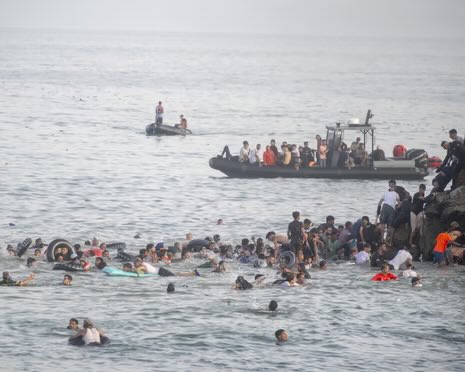
On Thursday, July 30, 2026, an estimated 49,000 migrants crossed into the Spanish North African territory of Ceuta from Morocco within a 24-hour period. This unprecedented influx occurred via both land and sea, with videos and images circulating showing thousands swimming into the city. Local media reported that crossings continued overnight into Friday, July 31. Spanish officials confirmed that at least 18 individuals died during these attempts to reach the territory. In response to the overwhelming numbers and what one Spanish official described as a 'total collapse' of the border, Spain deployed its armed forces to bolster security in Ceuta and its sister city, Melilla, where 300 to 400 crossings were also reported. The sudden surge followed several days of increased arrivals, with the success reportedly spreading quickly among potential migrants.
The crisis immediately triggered international reactions. Italy's Prime Minister swiftly commented on the events, describing the images from Ceuta as 'shocking' and labeling 'uncontrolled immigration' a security threat to Europe. She suggested Italy might consider suspending the Schengen zone agreement with Spain, although the practical implications for non-neighboring countries remain unclear. Spain's Foreign Minister, José Manuel Albares, condemned these remarks as 'improper' for a partner country, accusing Italy of 'partisan demagoguery' and summoning the Italian ambassador to Madrid on Friday.
What the Evidence Establishes
Evidence establishes that approximately 49,000 migrants entered Ceuta from Morocco on July 30-31, 2026, a figure representing more than half of the city's population of 83,600. This mass crossing resulted in at least 18 confirmed deaths. The Spanish government responded by deploying its military to secure the borders of both Ceuta and Melilla. The influx included a significant number of minors, with officials estimating at least 7,000 illegal crossings by individuals under 18 years old within the 24-hour period. The migrants, many of whom were young men, utilized both swimming routes and land approaches, with some reportedly walking along rocks on a jetty to bypass initial defenses.
The event follows a recent ruling by Spain's Supreme Court earlier this month, which determined that migrants intercepted at sea attempting to reach Ceuta or Melilla cannot be summarily returned to Morocco. This legal precedent may have influenced the timing or scale of the crossings. Furthermore, the Spanish interior ministry has publicly stated its commitment to working with Morocco to ensure the 'return of all who crossed illegally into its territory as soon as possible.' The diplomatic fallout includes a direct confrontation between Spain and Italy, with Spain summoning the Italian ambassador over comments regarding 'uncontrolled immigration' and potential Schengen zone implications.
Where the Accounts Conflict
While the scale of the migrant influx and the resulting fatalities are largely corroborated across reports, the precise reasons for the sudden and overwhelming surge, particularly regarding the actions of Moroccan authorities, remain unclear and represent a point of conflict or ambiguity. The BBC report explicitly states, 'It's not clear where the Moroccan border guards were at this point and why the groups of migrants were not dispersed or stopped.' This lack of clarity suggests a potential divergence in understanding or reporting on Morocco's role in facilitating or failing to prevent the crossings.
Spanish officials had previously appealed to Madrid for assistance following a recent increase in attempted crossings, indicating a known, albeit smaller, pressure point. However, the sudden breakdown of border controls on Thursday, allowing thousands to approach the border fence with ease, contrasts sharply with typical attempts where migrants swim several kilometers. This raises questions about whether Moroccan authorities actively permitted the crossings, passively failed to intervene, or were simply overwhelmed. The source material does not provide a definitive explanation for Morocco's posture, leaving this aspect open to interpretation and potential future clarification.
Context and Stakes
Ceuta, along with Melilla, represents the European Union's only land borders with Africa, making them perennial flashpoints for migration attempts into Europe. Both cities are coveted by Morocco, which asserts sovereignty over them, creating a long-standing diplomatic tension with Spain. This current crisis echoes a similar, though smaller, surge in 2021 when approximately 8,000 people crossed into Ceuta after Moroccan authorities allowed it during a diplomatic dispute with Madrid over the sovereignty of the Western Sahara. The recent visit by Spanish Prime Minister Pedro Sánchez to Algeria, which supports independence for Western Sahara, suggests a potential re-escalation of this diplomatic friction, possibly influencing Morocco's current border posture.
The stakes are significant, extending beyond Spain and Morocco to the broader European Union. Italy's Prime Minister's comments about 'uncontrolled immigration' posing a 'security threat to Europe' and the suggestion of suspending the Schengen zone agreement highlight the potential for wider European political and security implications. While the practicalities of Italy suspending Schengen with Spain are questionable given their geographical separation, the rhetoric itself underscores the fragility of intra-EU relations on migration policy. The crisis places immense pressure on Spain's resources and its diplomatic relationship with Morocco, a critical partner in border control for the EU.
What to Watch Next
Observers should closely monitor the efforts by Spain's interior ministry to coordinate with Morocco for the return of the migrants. The success and speed of these returns will indicate the current state of diplomatic cooperation between Madrid and Rabat, especially in light of the recent Western Sahara-related tensions. Any public statements or actions from Morocco regarding its border control policies will be crucial. The Spanish government's capacity to process and manage the thousands of new arrivals within Ceuta, particularly the estimated 7,000 minors, will also be a key operational challenge to watch.
Diplomatically, the fallout from Italy's comments and Spain's summoning of the Italian ambassador will require attention. Further statements from Italian officials or other EU member states regarding the Schengen zone or broader immigration policy could signal a deepening rift within the bloc. The European Union's official response, including any offers of aid or coordinated policy shifts, will also be important. Finally, any developments in the underlying diplomatic dispute between Spain and Morocco concerning Western Sahara could provide further context for future border control dynamics.
Bottom Line
The Spanish enclave of Ceuta experienced an unprecedented influx of approximately 49,000 migrants from Morocco within 24 hours, resulting in 18 deaths and prompting Spain to deploy its military. This mass crossing, which overwhelmed local border controls, has immediate humanitarian and security implications for Spain and its North African territories. The event has also ignited a diplomatic dispute with Italy over immigration policy and the future of the Schengen zone, underscoring broader European vulnerabilities and disagreements on border management.
The underlying causes appear to be a complex interplay of migrant opportunism, potentially relaxed Moroccan border enforcement linked to ongoing diplomatic tensions with Spain over Western Sahara, and the recent Spanish Supreme Court ruling on migrant returns. The crisis highlights the persistent challenges at the EU's external borders and the intricate geopolitical dynamics between Spain, Morocco, and other European partners. The immediate focus remains on managing the humanitarian situation in Ceuta and navigating the diplomatic fallout, while the long-term implications for regional stability and EU migration policy are significant.
DECLASSIFIED SOURCE: Operative Telegram Feed (via Real-time Signal Upgrade)
The article claims 49,000 people crossed in a single 24-hour window, but it fails to account for the logistical impossibility of that volume moving through a single enclave without a massive, documented surge in marit...
People keep complaining about the chaos but they ignore the sheer scale of 49,000 people in a single day. You can't argue with that math no matter how much you want to. Watch for the EU to start funding more maritime...
Everyone is talking about the military deployment, but the real issue is the 24-hour window for 49,000 people. That volume suggests a coordinated failure or deliberate opening of the border on the Moroccan side, which...
...