Tech Selloff Drags Nasdaq 1.4% Lower as Oil Plunges 7% on Iran Diplomacy Hopes Ahead of Midterms
By Operative Telegram FeedS&P 500 falls 0.5% while Nasdaq 100 drops 1.4% as AI capex fears outweigh crude crash; Oracle seeks $10B, Meta eyes $20B debt.
What Happened
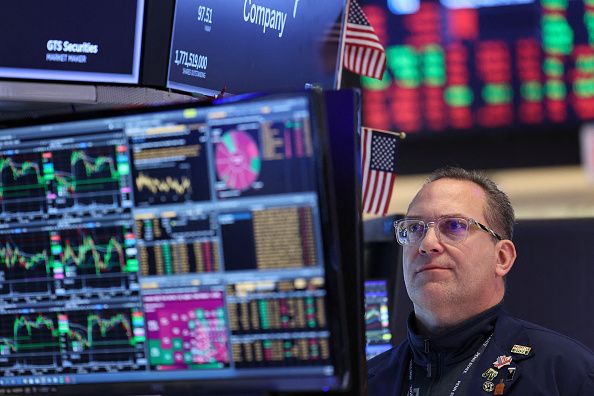
U.S. equities closed mixed on Monday, November 2, 2026, with the S&P 500 declining 0.5% to 7,541.40 and the Nasdaq 100 sliding 1.4% to 27,989.82, while the Dow Jones Industrial Average rose 0.4% to 51,983.98. The selloff concentrated in technology and semiconductor names: the VanEck Semiconductor ETF (SMH) and iShares Semiconductor ETF each fell between 2.7% and 3.7%, led by declines in Nvidia (NVDA), AMD, Micron (MU), and Broadcom (AVGO). The Vanguard Information Technology ETF (VGT) dropped 4%. Simultaneously, Brent crude tumbled 7.63% to settle at $104.77 per barrel and West Texas Intermediate futures fell 7.36% to $96.46, the sharpest single-day decline in months, after Secretary of State Marco Rubio stated President Donald Trump has not decided on military action against Iran and prefers a peaceful resolution, while Iranian state media cited their foreign minister saying a deal remains achievable if Washington shows goodwill. The moves came as National Guard members in at least seven states prepared for roles around Tuesday's midterm elections.
What the Evidence Establishes
Market data confirms the S&P 500 lost 0.5%, the Nasdaq 100 shed 1.4%, and the Dow gained 0.4% on November 2. The Russell 2000 dipped 0.2%. SPDR S&P 500 ETF (SPY) fell 0.5%, SPDR Dow Jones Industrial Average ETF (DIA) added 0.4%, and Invesco QQQ Trust (QQQ) dropped 1.4%. Brent crude closed at $104.77, down 7.63%; WTI settled at $96.46, down 7.36%. Oracle (ORCL) announced a $10 billion debt offering alongside an equivalent stock sale on Monday. Meta Platforms (META) is considering a $20 billion multi-currency bond issuance. Anthropic disclosed a twelve-fold revenue increase for the September quarter in a new filing. Palantir (PLTR) reported third-quarter earnings beating consensus, though valuation concerns pressured the stock. Apple (AAPL) posted fourth-quarter revenue above estimates but issued a disappointing Q1 outlook. Deutsche Bank said CrowdStrike (CRWD) shares could gain further after doubling year-to-date. AST SpaceMobile (ASTS) fell 11% on reports SpaceX is in talks with EchoStar to acquire Boost Mobile. Retail sentiment on Stocktwits for SPY improved to 'bullish' from 'neutral', while DIA and QQQ remained 'bearish'.
Where the Accounts Conflict
Contradictory signals emerge across asset classes and geopolitical messaging. Retail sentiment for SPY turned bullish even as institutional flows exited tech, with QQQ sentiment stuck in bearish territory — suggesting a divergence between individual investors buying the dip and larger participants reducing exposure to AI-exposed names. On the diplomatic front, Rubio's statement that Trump 'has yet to decide on military action' while emphasizing a preference for peace contrasts with Iranian state outlets quoting their foreign minister that a deal 'remains achievable provided Washington shows goodwill' — each side framing the other as the obstacle. Meanwhile, Trump touted the oil-price drop in his closing midterm speech, claiming credit for the decline, yet the price move coincided with reported diplomatic progress rather than domestic supply actions. The source does not provide details on whether the Iranian foreign minister's comments were made directly to U.S. counterparts or through public channels, leaving the negotiation channel ambiguous. Matt Maley of Miller Tabak noted the week would bring both political and geopolitical issues to decipher, underscoring that market participants themselves are uncertain which narrative will dominate.
Context and Stakes
The Monday session encapsulated three converging risk vectors: AI capital-expenditure skepticism, midterm election uncertainty, and Middle East diplomacy. Hyperscalers are increasing debt burdens to fund AI buildout — Oracle's $10 billion combined debt-and-equity raise and Meta's potential $20 billion bond issuance signal that internal cash flows are insufficient for the current pace of infrastructure spending. Anthropic's twelve-fold revenue jump demonstrates demand exists, but investors question whether returns justify the spending trajectory. The semiconductor selloff reflects this skepticism: Nvidia, AMD, Micron, and Broadcom all declined sharply, dragging SMH and VGT down 2.7%-4%. Politically, National Guard deployments in at least seven states for Tuesday's midterms indicate heightened security concerns around election integrity. A shift in congressional control could alter fiscal policy, tech regulation, and oversight of executive branch diplomacy. On Iran, the 7.6% crude drop — the largest in months — shows markets are pricing a reduced probability of supply disruption. If diplomacy fails, the snapback rally in oil could reignite inflation fears and complicate Federal Reserve policy. The source does not provide details on specific National Guard missions or which seven states are involved.
What to Watch Next
Three near-term catalysts will determine whether Monday's moves extend or reverse. First, Tuesday's midterm results: a Republican sweep could embolden Trump's Iran posture and extend tax-cut expectations, while a Democratic chamber could constrain executive action and increase oversight of AI exports. Second, Iran diplomatic signals: any statement from Trump, Rubio, or Iranian officials in the next 48 hours confirming or denying progress will move crude immediately — a breakdown could push Brent back above $110. Third, corporate execution: Oracle's debt pricing and Meta's bond terms will test investor appetite for AI capex funding; weak demand could force equity dilution or project delays. The Federal Reserve's next policy meeting on November 4-5 (per historical schedule) will incorporate the oil-price drop into inflation forecasts. The source does not provide details on the Fed meeting date or specific Oracle/Meta issuance timelines. Additionally, Palantir's government contract pipeline and Apple's Q1 guidance walkback merit monitoring for tech-sector breadth signals.
Bottom Line
Monday's session revealed a market pricing two competing narratives: AI capex skepticism dragging growth stocks lower, and Iran diplomacy hopes slashing energy costs. The Dow's gain amid a tech-led Nasdaq decline shows rotation, not broad risk-off. Oracle and Meta turning to debt markets at scale confirms the AI buildout is outpacing free cash flow — a structural funding gap that will persist until revenue conversion accelerates or spending slows. The 7.6% oil drop is the largest single-day geopolitical dividend in months; if sustained, it lowers CPI pressure and gives the Fed room to pause. But the diplomatic channel remains opaque — Rubio's 'has not decided' language preserves military optionality, and Iran's 'goodwill' condition is unverifiable. Tuesday's midterms add a legislative wildcard: divided government historically produces gridlock, which markets often prefer, but could also stall permitting reform needed for domestic energy production. The convergence of election results, Iran talks, and mega-cap financing this week creates a rare density of binary outcomes. Positioning for any single outcome carries asymmetric risk; the evidence suggests hedging across scenarios rather than betting on one.
DECLASSIFIED SOURCE: Operative Telegram Feed (via Real-time Signal Upgrade)