August Job Growth Exceeds Forecasts, Trump Demands Rate Cuts and Threatens Trade Action
By Operative Telegram FeedU.S. economy added 162,000 jobs in August, significantly surpassing economist predictions. Donald Trump called for lower interest rates, threatening trade action.
What Happened
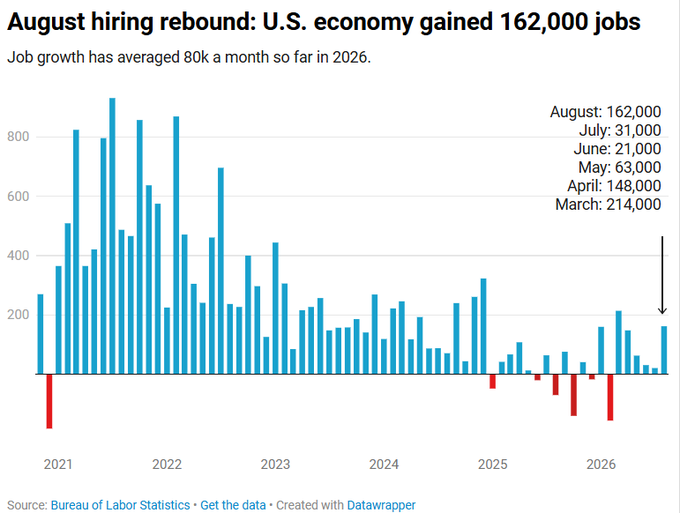
The United States economy added 162,000 jobs in August, a figure that substantially exceeded prior economist predictions. This robust job growth was accompanied by significant upward revisions to previous months' data, indicating a stronger labor market than initially reported. Former President Donald Trump reacted to the news on Truth Social, asserting that the job numbers broke "all estimates" and calling for the Federal Reserve to lower interest rates immediately. Trump argued that the U.S. is a "much stronger credit" and should possess the "LOWEST RATE of any country in the World." He further escalated his demands by threatening to "STOP TRADING WITH COUNTRIES WITH WHICH WE HAVE A DEFICIT" if interest rates are not reduced, referencing a Supreme Court decision on tariffs. Senator Tim Scott (R-SC) also commented on the report via X, praising the Trump administration and Congress for their focus on "American jobs from day one," highlighting the 162,000 private sector jobs added as evidence of "More jobs. More opportunity."
Specifically, the private sector contributed 127,000 jobs in August, far surpassing the 53,000 expected by economists. Manufacturing payrolls increased by 16,000, exceeding the 5,000 estimate. The July job loss estimate was revised upward by 44,000, transforming a reported loss of 23,000 into a gain of 21,000. Similarly, the June gain was revised up by 11,000 to 31,000. These revisions collectively added 55,000 jobs to the combined employment figures for June and July compared to earlier reports. Durable goods manufacturing alone added 15,000 jobs in August, following gains of 24,000 in July and 13,000 in June, underscoring broad-based strength in the industrial sector.
What the Evidence Establishes
The August jobs report definitively establishes a stronger-than-anticipated labor market, with 162,000 new jobs added, significantly outperforming the 55,000 jobs economists had predicted. This includes a substantial contribution from the private sector, which added 127,000 positions, nearly two-and-a-half times the 53,000 forecast. The manufacturing sector also demonstrated unexpected strength, with 16,000 new payrolls, tripling the 5,000 estimate. Crucially, the evidence confirms a pattern of upward revisions for previous months; the July job figures were adjusted from a loss of 23,000 to a gain of 21,000, and June's gain was increased by 11,000 to 31,000. These revisions collectively indicate that the economy generated 55,000 more jobs in June and July than initially reported, suggesting a sustained positive trend.
Former President Donald Trump's reaction on Truth Social is documented, where he explicitly stated, "EMPLOYERS ADDED 162,000 JOB IN AUGUST" and called for lower interest rates, arguing that "A STRONG COUNTRY MEANS A LOWER INTEREST RATE – IT’S A BETTER CREDIT." His threat to "STOP TRADING WITH COUNTRIES WITH WHICH WE HAVE A DEFICIT" if the Federal Reserve does not comply is also a direct quote, linking his economic policy stance to trade leverage. Senator Tim Scott's public statement on X, praising the administration's focus on "American jobs from day one" and citing the 162,000 private sector jobs, corroborates the political response to the economic data. The unemployment rate, which economists had predicted would rise to 4.2 percent from 4.1 percent, was not explicitly stated in the provided data, leaving its actual August figure unconfirmed by the immediate evidence.
Where the Accounts Conflict
The primary area of conflict lies not in the reported job numbers themselves, but in the interpretation and the divergence between actual outcomes and expert predictions. Economists had broadly anticipated a more modest gain of 55,000 jobs for August and an increase in the unemployment rate to 4.2 percent from 4.1 percent. The actual reported addition of 162,000 jobs directly contradicts these consensus forecasts, demonstrating a significant underestimation of labor market strength by economic analysts. Former President Donald Trump capitalized on this discrepancy, claiming the numbers "broke all estimates (except mine!) by double and triple," a statement that frames the outcome as a personal vindication against expert consensus.
While the raw data on job creation is consistent across the reporting, the framing of the Federal Reserve's role and appropriate monetary policy presents a clear conflict. Trump explicitly demanded that the "Fed Board, with its great new leader, must get smart – BE PATRIOTS for a change," advocating for immediate interest rate reductions. This stance directly challenges the Federal Reserve's traditional mandate of independent monetary policy focused on price stability and maximum employment, often operating without direct political pressure. The source does not provide the Federal Reserve's immediate reaction, leaving a gap in understanding how the central bank might reconcile strong job growth with potential inflationary pressures or political demands for rate cuts. The conflict is therefore between political pressure for specific monetary actions and the independent, data-driven approach typically espoused by central banks.
Context and Stakes
The robust August jobs report arrives at a critical juncture for both monetary policy and the broader political landscape. Strong job growth, while generally positive, can complicate the Federal Reserve's efforts to manage inflation, as a tight labor market often leads to wage pressures and increased consumer spending. The Fed has historically aimed for a 'soft landing,' cooling the economy enough to curb inflation without triggering a recession. Unexpectedly strong job numbers, like the 162,000 added in August, could signal that the economy remains overheated, potentially delaying anticipated interest rate cuts or even prompting discussions of further tightening, despite political calls for reductions. This creates a dilemma for the Fed, balancing economic stability with external pressures.
For former President Donald Trump, the jobs report provides a platform to reinforce his economic narrative ahead of upcoming elections. His demand to "Lower the interest rates" and his threat to "STOP TRADING WITH COUNTRIES WITH WHICH WE HAVE A DEFICIT" are consistent with his past "America First" economic policies, which prioritized domestic economic performance and aggressive trade stances. His reference to the U.S. Supreme Court's "ridiculous and very costly Tariff decision" underscores his belief in broad presidential authority over trade, suggesting a willingness to use executive power to achieve economic objectives. The stakes are high: the Fed's response will influence borrowing costs for businesses and consumers, market sentiment, and potentially the trajectory of inflation. Politically, Trump's strong reaction positions him as a vocal advocate for specific economic policies, potentially shaping public perception of economic competence and future policy directions.
What to Watch Next
Observers should closely monitor upcoming statements from Federal Reserve officials for any shifts in their monetary policy outlook following the unexpectedly strong August jobs report. Any indication of a change in the Fed's stance on interest rates, particularly regarding the timing or likelihood of cuts, will be critical. The market will be looking for signals on whether the Fed views this job growth as sustainable and non-inflationary, or if it suggests a need for continued vigilance against price pressures. Specific attention should be paid to speeches or press conferences by the Fed Chair or other governors in the coming days and weeks, as these will provide the most direct insight into the central bank's interpretation of the latest economic data and its implications for future policy decisions.
Furthermore, the political response to the jobs report, particularly from former President Donald Trump, warrants continued observation. Given his explicit threats to "STOP TRADING WITH COUNTRIES WITH WHICH WE HAVE A DEFICIT" if interest rates are not lowered, it will be important to see if his campaign elaborates on these trade policy proposals. This could include naming specific countries or trade blocs, or outlining the mechanisms through which such trade restrictions would be implemented. Any further details on his economic platform, especially concerning the interplay between monetary policy and trade, could significantly impact market expectations and international relations. The reactions from other political figures and economic analysts to Trump's specific demands will also provide insight into the evolving debate over economic management.
Bottom Line
The U.S. economy demonstrated unexpected strength in August, adding 162,000 jobs and significantly surpassing economist forecasts, with substantial upward revisions to prior months' data. This robust labor market performance indicates a resilient economy, but it also presents a complex challenge for the Federal Reserve as it navigates inflation concerns and political pressure. Former President Donald Trump reacted forcefully to the report, demanding immediate interest rate cuts and threatening to impose trade restrictions on countries with deficits if his demands are not met. His statements underscore a clear divergence between political expectations for monetary policy and the Fed's independent, data-driven approach.
The implications of this jobs report are far-reaching, affecting both financial markets and the political discourse surrounding economic management. The Federal Reserve's upcoming communications will be crucial in shaping market sentiment and expectations for future interest rate decisions. Simultaneously, Trump's continued articulation of aggressive trade and monetary policies will likely remain a central theme in the political arena, influencing public debate on economic sovereignty and global trade relations. The interplay between strong economic data, central bank independence, and political demands will define the immediate economic narrative.
DECLASSIFIED SOURCE: Operative Telegram Feed