Fauci's Private Diary Reveals Early Lab Leak Concerns, Contradicting Public Statements
By Operative Telegram FeedSen. Rand Paul released Dr. Anthony Fauci's diary, showing Fauci privately considered COVID 'deliberate insertion' and dismissed the market origin in Jan 2020, contradicting public statements.
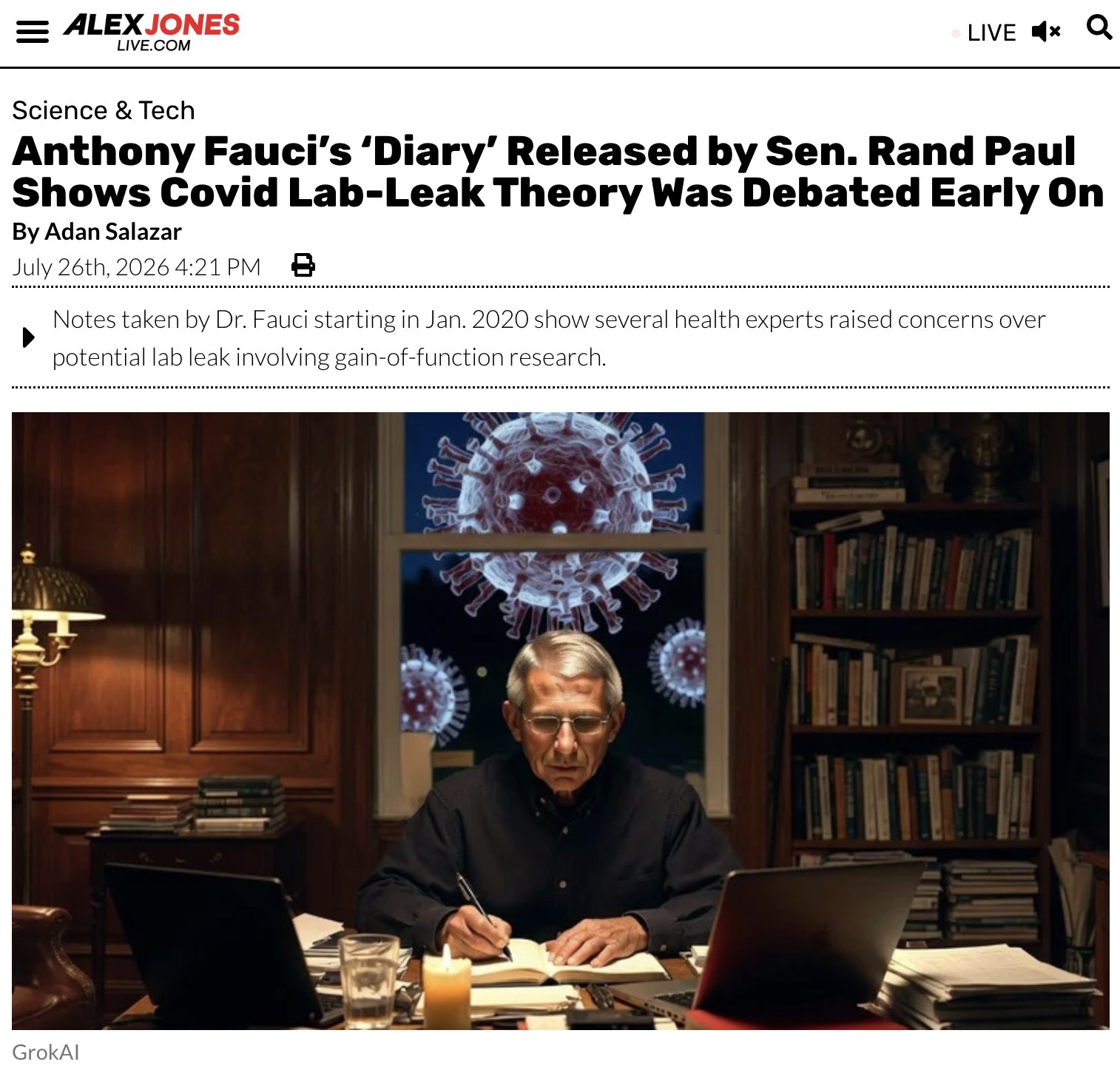
What Happened
On July 26, 2026, Senator Rand Paul (R-KY) publicly released portions of Dr. Anthony Fauci’s private diary, spanning entries from December 2019 through December 2022. The release, announced via Senator Paul's social media, highlighted a significant discrepancy between Fauci’s internal considerations regarding the origins of COVID-19 and his subsequent public pronouncements. Specifically, the diary entries detail a February 1, 2020, conference call involving twelve high-level scientists, where ten of them reportedly believed that “deliberate insertion was possible” concerning the virus’s spike protein. This internal discussion occurred at a critical juncture in the pandemic's early stages, as global health authorities were attempting to ascertain the virus's genesis. The diary also notes that as early as January 26, 2020, Fauci privately concluded that the Wuhan wet market was “not the source, it was the amplifier,” a position that diverged from initial public narratives.
The diary further reveals that a day prior to the February 1 conference call, scientists expressed concerns that the “spike protein could not have occurred naturally since it would require an evolutionary jump that they found nowhere in bat isolates.” Fauci’s notes indicate these scientists raised the possibility of the virus being “deliberately inserted and either accidentally released or deliberately released by a crazy person in the lab, the former being the most likely.” These private reflections stand in stark contrast to Fauci’s later public statements, such as his May 2020 interview with National Geographic, where he dismissed lab leak claims as “circular arguments” and asserted the virus was “totally consistent” with an animal-to-human jump. Senator Paul, a long-standing critic of Fauci’s handling of the pandemic and his stance on the lab leak theory, emphasized these contradictions as part of his ongoing investigation into COVID-19 origins.
What the Evidence Establishes
The released diary entries from Dr. Anthony Fauci establish that, by early 2020, he was aware of significant scientific concerns regarding the natural origin of the SARS-CoV-2 virus. Specifically, on February 1, 2020, during a conference call with twelve scientists, ten participants reportedly considered the possibility of “deliberate insertion” of the spike protein, a key feature of the virus. This concern was rooted in the observation that the spike protein’s structure seemed to require an “evolutionary jump” not found in known bat isolates, suggesting potential genetic engineering. Fauci’s notes explicitly mention Dr. Zheng-Li Shi of the University of Wuhan and her work on gain-of-function research, which aimed “to allow adaptation of the spike protein to bind to the human ACE2 receptor.” This detail directly links the internal scientific discussions to specific research activities at the Wuhan Institute of Virology.
Furthermore, the diary entries confirm that as early as January 26, 2020, Fauci privately acknowledged that the Wuhan wet market was “not the source, it was the amplifier.” This internal assessment predates and contradicts the public narrative, which for months, often centered on the market as the primary origin point for the pandemic. The evidence from Fauci’s own hand demonstrates a clear divergence between his private understanding and the public messaging he later promoted. For instance, in a May 2020 interview, Fauci publicly dismissed lab leak theories as “circular arguments” and stated the virus was “totally consistent” with zoonotic spillover. The diary provides direct, contemporaneous documentation of Fauci’s internal deliberations and the scientific opinions he was privy to, offering a factual basis for the claim that his private views differed from his public statements on the virus's origins.
Where the Accounts Conflict
The primary conflict arises between Dr. Anthony Fauci’s private diary entries and his public statements regarding the origins of COVID-19. In his diary, specifically on February 1, 2020, Fauci recorded that a majority of scientists on a high-level conference call, ten out of twelve, believed “deliberate insertion was possible” concerning the virus’s spike protein. He also noted concerns about the spike protein requiring an “evolutionary jump” not seen in bat isolates, and the possibility of accidental or deliberate release from a lab. Crucially, an entry from January 26, 2020, states, “Now we know the market was not the source, it was the amplifier.” These private acknowledgments indicate a serious consideration of the lab leak theory and a dismissal of the market as the origin point.
In stark contrast, Fauci publicly dismissed such theories. In a May 2020 interview with National Geographic, he characterized lab leak claims as “circular arguments” and asserted that the virus was “totally consistent” with an animal-to-human jump. Senator Rand Paul has consistently highlighted this discrepancy, accusing Fauci of suppressing the lab leak theory. The conflict is not merely one of interpretation but of direct factual contradiction between Fauci’s documented private thoughts and his public pronouncements. While Fauci’s public statements aimed to present a unified front on the virus’s origins, his diary reveals a more complex internal debate and a greater acceptance of the lab leak hypothesis among scientists he consulted, which was not conveyed to the public. This conflict forms the core of Senator Paul's ongoing scrutiny and the basis for Fauci's upcoming testimony.
Context and Stakes
The context for these revelations is the ongoing, highly politicized debate surrounding the origins of the COVID-19 pandemic, which has claimed millions of lives globally and caused unprecedented economic disruption. The lab leak theory, initially dismissed by many mainstream scientific and political figures, has gained increasing traction as more information becomes available. Dr. Anthony Fauci, as the long-serving Director of the National Institute of Allergy and Infectious Diseases (NIAID) and a prominent figure in the U.S. pandemic response under both President Trump and President Biden, played a central role in shaping public understanding and policy. His alleged suppression of the lab leak theory, as suggested by Senator Rand Paul, carries significant implications for public trust in scientific institutions and government transparency.
The stakes are substantial. If Fauci knowingly downplayed a credible lab leak hypothesis while privately acknowledging its possibility, it raises questions about scientific integrity, the influence of political considerations on public health messaging, and accountability for the pandemic's origins. The mention of Dr. Zheng-Li Shi and gain-of-function research at the Wuhan Institute of Virology further complicates the geopolitical landscape, particularly U.S.-China relations. Understanding the true origin of the virus is critical not only for historical accuracy but also for preventing future pandemics and establishing protocols for international scientific collaboration and oversight. The ongoing congressional investigations, spearheaded by figures like Senator Paul, aim to uncover the full extent of internal discussions and decision-making processes during the early days of the pandemic, with potential consequences for the reputations of key individuals and the credibility of public health agencies.
What to Watch Next
The immediate focus will be on Dr. Anthony Fauci’s upcoming testimony before the Senate Homeland Security and Governmental Affairs Committee, scheduled for next Wednesday. Senator Rand Paul, who released the diary entries, is a member of this panel and is expected to directly confront Fauci with the contents of his private notes. This hearing will likely feature intense questioning regarding the discrepancies between Fauci’s private considerations and his public statements on the lab leak theory and the Wuhan wet market. Observers will be watching for Fauci’s explanations for these contradictions and whether he offers any new insights or clarifications regarding the scientific discussions from early 2020.
Beyond the testimony, attention will turn to potential follow-up actions by Congress. Senator Paul has previously demanded the declassification of official COVID-era documents and communications connected to Fauci. The revelations from the diary could intensify calls for further declassification or even new investigations into the National Institute of Allergy and Infectious Diseases and its funding of gain-of-function research. The scientific community will also be scrutinizing any new details that emerge, potentially reigniting debates about research ethics and the need for greater transparency in virological studies. The political ramifications for both Fauci and Senator Paul, as well as the broader Republican effort to hold pandemic-era officials accountable, will be closely monitored in the coming weeks and months.
Bottom Line
Dr. Anthony Fauci’s recently released private diary entries from early 2020 reveal that he and a significant number of consulting scientists seriously considered the possibility of a “deliberate insertion” of the COVID-19 virus and quickly dismissed the Wuhan wet market as its origin. These internal deliberations directly contradict Fauci’s subsequent public statements, where he characterized lab leak theories as “circular arguments” and emphasized a natural zoonotic origin. The evidence establishes a clear divergence between Fauci’s private understanding of the scientific landscape and the public narrative he helped shape.
This discrepancy has significant implications for public trust in scientific leadership and government transparency during crises. Senator Rand Paul’s release of these documents intensifies the ongoing debate over COVID-19 origins and sets the stage for a contentious congressional hearing next Wednesday, where Fauci is expected to face direct questioning on these revelations. The core issue remains whether public health officials provided a complete and accurate picture of scientific uncertainties to the public, or if alternative theories were deliberately downplayed. The outcome of these investigations will likely influence future public health communication strategies and accountability measures for government scientists.
DECLASSIFIED SOURCE: Operative Telegram Feed (via Real-time Signal Upgrade)