AfD Claims Saxony-Anhalt Victory Amid Coalition Blockade
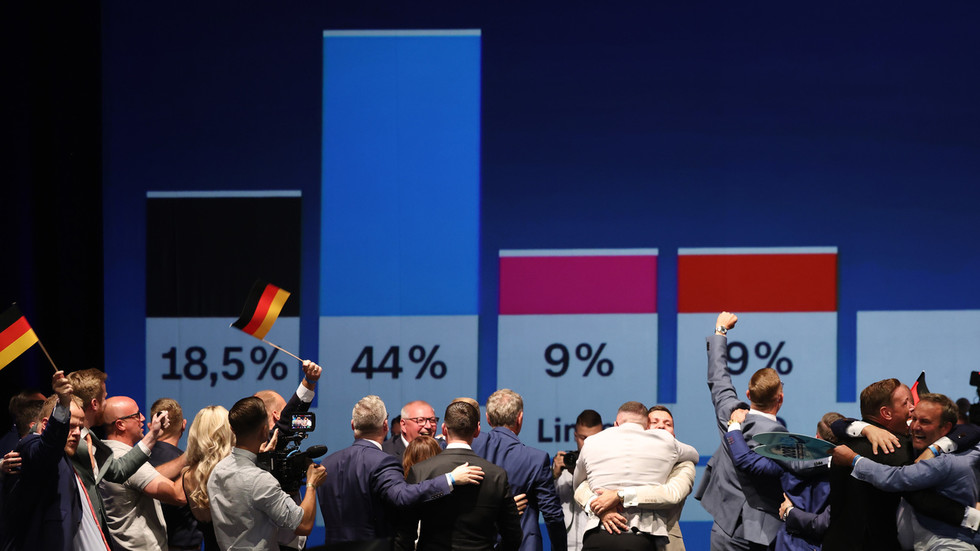
By RT - NewsExit polls show AfD winning Saxony-Anhalt with about 44% of the vote, more than double its 2021 result, while other major parties refuse to cooperate, threatening government formation.
What Happened
On September 6, 2026, voters in Saxony-Anhalt participated in a regional state election. According to an Operative Telegram Feed post timestamped 2026-09-06T23:35:04.967Z, the Alternative for Germany (AfD) declared victory with approximately forty‑four percent of the vote. The post described the result as a “gigantic landslide” and noted that the AfD surged close to +24 points compared to its performance in the previous state election.
The same Telegram message included a link to a video posted by Eric Daugherty (@EricLDaugh) and claimed that former U.S. President Donald Trump had shared the news on social media, adding a celebratory emoji.
Al Jazeera’s news segment, published 2026-09-06T21:25:06.060Z, reported that the AfD’s projected vote share was around 44 percent, characterizing it as more than double its result from five years earlier.
Al Jazeera also highlighted that, despite the strong showing, the AfD faces an uphill battle to form a state government because other major parties have ruled out working with it.
What the Evidence Establishes
The AfD’s vote share in Saxony-Anhalt is established at roughly forty‑four percent, based on exit poll data cited by both the Operative Telegram Feed and Al Jazeera. This figure represents a significant increase from the party’s performance in the 2021 state election, which the sources describe as less than half of the 2026 outcome.
Both sources explicitly state that the AfD declared victory; the Telegram post uses the phrase “DECLARES VICTORY” and the Al Jazeera segment confirms the projection.
The sources agree that other major parties have publicly ruled out any coalition or cooperation with the AfD in Saxony-Anhalt, creating a barrier to government formation.
The Telegram post adds contextual claims about Elon Musk’s backing and Donald Trump’s social media endorsement, while Al Jazeera frames the outcome in historical terms, questioning whether AfD could become Germany’s first far‑right state government since World War II.
Where the Accounts Conflict
The primary point of divergence lies in the interpretation of the AfD’s victory. The Operative Telegram Feed presents the result as a decisive, celebratory breakthrough, employing emphatic language such as “gigantic LANDSLIDE” and highlighting external endorsements from Elon Musk and Donald Trump.
Al Jazeera’s coverage, while confirming the vote share, adopts a more cautious tone, focusing on the structural obstacles to governance and posing the question of whether a far‑right party can actually assume state power.
Neither source disputes the numeric vote share or the fact that other parties refuse to cooperate; the conflict is limited to framing—whether the outcome signals a transformative political shift or a symbolic gain hampered by institutional resistance.
No contradictory figures regarding voter turnout, vote counts, or election dates appear between the two sources; both reference the same election day of September 6, 2026.
Context and Stakes
Historically, far‑right parties in Germany have been excluded from governing coalitions at the federal level since World War II, and state‑level participation has been rare and short‑lived. The AfD’s current surge to approximately forty‑four percent in Saxony‑Anhalt marks its strongest showing in a state election to date.
The stake is the potential formation of the first far‑right‑led state government in postwar Germany, which would break a longstanding political taboo and could influence national debates on immigration, sovereignty, and European Union policy.
Conversely, the unified refusal of other major parties to cooperate preserves the existing centrist‑dominated governing architecture but risks deepening voter polarization and potentially fueling further support for the AfD in future elections.
Financial markets have not shown a direct reaction in the available sources; therefore, the immediate fiscal impact remains uncertain, though prolonged governance instability could affect regional investment confidence.
What to Watch Next
Within the next 48 hours, political analysts will monitor whether the AfD attempts to claim a formal mandate and seeks exploratory talks with smaller parties or independent legislators, despite the stated opposition from the CDU, SPD, Greens, and FDP.
Over the following two to three weeks, the state parliament’s inaugural session will be convened; observers will watch for any procedural motions, such as a vote of confidence or a proposal for a minority government, and for public statements from party leaders reiterating or softening their non‑cooperation pledges.
In the medium term (approximately one to two months), the AfD may pursue legislative initiatives or policy proposals to demonstrate governing capability, even without formal coalition partners, potentially testing the limits of the state’s constitutional framework.
Bottom Line
The evidence confirms that the AfD secured roughly forty‑four percent of the vote in Saxony‑Anhalt’s September 6, 2026 election, a marked increase from its prior performance.
However, the simultaneous and explicit refusal of other major parties to cooperate creates a substantial obstacle to the AfD forming a stable state government, making a minority administration, prolonged negotiations, or a repeat election the most plausible near‑term outcomes.
Unless the political landscape shifts—such as a change in stance by one of the blocking parties or a significant alteration in public opinion—the AfD’s electoral victory is likely to remain a symbolic milestone rather than a gateway to executive power in the state.
DECLASSIFIED SOURCE: RT - News (via Real-time Signal Upgrade)